Showing posts with label postcolonialism. Show all posts

Thursday, August 27, 2020

Designing an Asian Colonial-Era Sandbox - Part 2 (Representation), but this actually became a full-length essay

You can't talk about designing anything for play 1) during the Colonial era and 2) in a pseudo-Asian setting today without talking about the representation of cultural tropes.

Problem the first: One problem with designing non-generic D&D has to do with implicit tropes that players/GMs might not have access to. OSR D&D can get away with brevity because it relies so much on a shared pop-cultural knowledge: nobody needs to be told what a 'goblin' is, everybody understands the Baron is somebody important. 

In TTRPGs, where the curated space is imaginative and shared, the work of presenting new tropes is doubly hard. The GM has to learn / adopt new tropes AND communicate them to the players, AND the table then has to engage in a shared construction of the play-space. Basically: it's hard to get a table to imagine tropes they're not already familiar with. 

(Sidenote: Electric Bastionland and the UVG are interesting to me because they ALSO draw on implicit tropes, just not 'generic' fantasy ones. EB evokes tropes about the City, and the experience of living in an urban space. UVG draws on Mad Max, psychedelia, Dune, and maybe Barsoom - edit: especially the art of Moebius)

Edgar Rice Burroughs: Beasts of Barsoom

Problem the second: When introducing tropes to do with real-world cultures, there's a tricky line between appreciating and parodying. More so because today, the line between 'Cultural Appreciation' and 'Cultural Appropriation' is thin, and seems to shift constantly. What discussions of 'Cultural Appropriation' can miss is that everyone is engaged in an artificial construction of 'culture'. My experiences as a Chinese person living as part of a diaspora in a 21st century city are worlds apart from the experiences of a Chinese person in 19th-century Qing Dynasty China. The experiences of a 21st century British person playing through D&D are worlds apart from the cultural assumptions of, say, 15th century Chivalric fiction (which is itself distinct from the experience of actually living in the 15th century), but there isn't that baggage of 'appropriation' if you get knights wrong. 

Problem: my imaginative space labelled 'East Asia' is a melting pot of Hong Kong martial arts movies and Zhang Yimou films and Ghost in the Shell and Hayao Miyazaki and the time I took a trip to see the Forbidden Palace in Beijing. I'm making it up too. 

Essentially, when I talk about designing an 'Asian' setting, I'm constructing an artificial pastiche of ideas as much as anybody else. Obviously, this doesn't mean that anyone should throw together some Asian tropes and call it, say 'Oriental Adventures'. But it does mean there is no platonic ideal of cultural representation, because what exactly does it mean to be, eg, 'authentically Korean' in the 21st century? Products that claim to be culturally 'authentic' are really just throwing around marketing buzzwords.

Oriental Adventures - Wikipedia

TTRPGs striving for 'authentic' might try their hardest to evoke 'Asian' tropes, but they often end up flattening them. I once attended a cross-cultural business talk about doing business in China (it was a bit like an out-of-body experience). The speaker (not Chinese) talked about the importance of face and shame culture and authority, which is a bit like someone insisting the keystones to British culture are tea and not making a fuss. Like, kind of, but not really? 

This also applies to POC/Asians writing in diaspora culture. It is tempting for me to flatten Chinese culture into, say 'kinship ties', and then pretend that this motivates all sorts of behaviour, when really, people are people everywhere you go. They have similar motivations: they love their kids. They don't want to starve to death. They try to avoid harming people they care about. They like things being comfortable, and predictable, and generally don't like extreme change. Emphasising cultural difference can exoticize, when I think there's more that unites us as humans than sets us apart. 

How many TTRPG East-Asian influenced products start with chapters waxing lyrical about 'The Way of the Samurai', or 'Duty and Honour', or some reference to the Tao or the Elements or the Spirits of Air and Water, as if these were the keys to comprehending what 'Asian' is? 

(Sidenote 1:This is also the same problem that European representations of Asia have had for ages, the idea that understanding some cultural mythos is key to interpreting political behaviour. See 19th century attempts to essentialise Chinese culture from Staunton's translation of the Qing legal code, or for a more modern version, how Frances Fitzgerald's 'Fire in the Lake' tried to explicate Vietnam War revolutionaries by saying that the Vietnamese were just culturally different, rather than engage with how American policy consistently alienated the populace for very evident reasons.) 

(Sidenote 2: About the use of the word 'Asian'. I've never actually heard the label 'Asian' used self-descriptively, outside of places with overseas diaspora communities like the US and the UK. In South-East Asia, people will say they are Thai or Korean or Chinese, because there are large differences between these cultures. You might get discussions about 'Asian parenting styles' or 'Asian education', but it's as broad as the term 'Westerner'.

...There's a whole 'nother discussion about how/why 'representation' is much more of a concern for overseas diaspora cultures or minority cultures than majority-cultures. Koreans in South Korea are generally far less concerned about 'representation' than Korean-Americans in the US.)

Problem the third: TTRPGs rely on a shared understanding of how the world works in order for players to take meaningful actions. At the most basic level, players need to assume that real-world physics are in play in order to meaningfully make a boulder-trap. At a social level, players expect that their actions will evoke comprehensible reactions from others. Certain actions are laudable and win respect. Other actions are reprehensible and incur disapproval. While sometimes GMs can play with this expectation to create a twist (eg the monster the PCs killed is actually sacred to the villagers, and now everyone is mad), a world that functions on very different social dynamics is one where PCs end up feeling continually alienated and bewildered. 

In a continuation from Problem the Second, this is why so many TTRPGs that try to 'represent Asia' (usually China or Japan), insert very unsubtle mechanisms for guiding PCs to engage with 'Asian' dynamics. Thus, you have giri tracks and honour points and Face scores or whatever mechanic, to try and get players to engage with these different (and implicitly alien) social dynamics. The idea is that players are meant to learn how culturally distinct this setting is, but it ends up being like Romance Points in Mass Effect, where if you hit the 'nice' option enough you can get an NPC to sleep with you.

If I get 12 more honour points, the Daimyo will give me a castle! 

Oh no, this betrayal has hurt my Giri-score. My PC is now depressed.

It's a bit like trying to make an 'American RPG' where PCs constantly have to manage 'Freedom Points' as a metacurrency. You could, but it would scan as parody, wouldn't it? 

L5R RPG – Strange Assembly

MY GRAND UNIFYING SOLUTION: 

Give up, and don't bother. Thanks for coming to my TED talk.

WAIT REALLY?

Yes, really! 

I'm not aspiring to make a 'culturally authentic' setting, partly because I'm drawing inspiration from India/China/Japan so it's all pastiche anyway, and partly because I'm more interested in creating a space that explores a period, and letting people fill in the blanks. 

Put another way, nobody plays D&D-as-written to get in touch with, say, their Irish-Catholic roots. But you can bet there's an Irish-Catholic GM and their players somewhere who've put something of their childhood into the NPCs or settings or locations they wrote up. I want a D&D where people like me can put in Oni and Hungry Ghosts and Fortune Cats if they want to, and not feel like they're setting up shop over Tolkien's grave.

This means that setting-creation will be collaborative. I'm hoping I can write something that any group can riff off-of, rather than something where people outside South-East Asia don't dare to play it because they'll do it 'wrong'. 

...THAT'S A LOT OF WORDS FOR JUST D&D WITH SERIAL NUMBERS FILED OFF

Well, not quite. 

Even if the actual cultural touchstones are hazy, I'm still calling it 'Asian Colonial-Era Sandbox Play' because I want it to evoke a broad experience. Even if you're playing members of a mushroom-empire getting colonised by psychic moles and mecha-squids, there's certain genre assumptions and principles to guide play. 

If anything, I want to represent the material experience of colonisation interacting with the fall of empire. I want to complicate the narrative that colonialism involves bad actors with agency attacking a passive victim. I want PCs to consider if collusion makes sense in the moment, even if the wider consequences are to accelerate the collapse of a failing structure.

There'll be tea-houses and calligraphy schools and officials in sedan chairs. It will probably be entirely implicit in the random tables I draft, and vague enough to leave lots of gaps. I also want to preserve the weirdness of the OSR, so like it'll probably be caterpillar-men carrying sedan chairs.

I also really appreciated Chris McDowall's short, punchy guides for how to describe locations and types of characters in Electric Bastionland. I could probably do something similar for officials, villagers etc. 

PRINCIPLES FOR REPRESENTING THE FALL OF EMPIRE / COLONIALISM (First pass)

1. EVERYONE IS A PERSON
This is the most important one. The tribespeople are people. The colonialists are people. The emperor's court is full of people. Everyone has motivations for what they're doing. Their motivations could be wrong, superstitious, selfish or corrupt, but they're still understandable motivations.

2. THE EMPIRE IS THE WORLD
The collapsing empire is the centre of play, in the same way that the Middle Kingdom is better translated as The Central Kingdom or The Centre of Everything. There's other places, but they are all judged in relation to the empire. 

3. THE EMPEROR IS FAR AWAY, LONG LIVE THE EMPEROR
The sources of moral authority in the empire are unchanged, even if the material reality is shifting. Experience first-hand the dissonance of everyone saying they respect and venerate the emperor even as they rebel against him, because 'well he's just very badly advised by corrupt eunuchs so THIS is his true will'. (See what I mean by 'everyone is more similar than different'? Compare: the complex relationships of monarchs with popes, when moral authority =/ material authority)

4. IF ANYONE IS REALLY ALIEN, IT'S THE FOREIGNERS
The PCs have an understanding of the culture they're in, though they might meet strange sects, cults or deviant groups that defy the norm. The foreigners? Emperor knows what they're about. Every foreign empire has customs that are incomprehensible and defy common sense to the PCs. Ask your players to make some up. If you have fantasy-France as a colonial power, add a little something that emphasises how alien they are. Maybe they eat their dead. Maybe public nudity is not a taboo. Just bear in mind rule 1.

5. COLLABORATE ON YOUR SETTING
Talk it out with your players as adults. Spend Session Zero discussing features of your setting, bring in the tropes that people want to see. My setting is influenced most by China, and a little bit of India and Japan, but if you want to do something themed around, say, Portuguese touchstones, why not?

6. SET BOUNDARIES
Additionally, there's all this other stuff in the Colonial-era that people might not want to deal with. Drugs and racism are very much a part of the Colonial Experience(TM), but if your table doesn't want to deal with that you can toss it out. Enthusiastic Pirate Bois has animal-races, which 1) makes it easier for PCs to remember that Moles hate Frogs and 2) is, for me at least, an acceptable level of fantasy racism. But do what works for your table. 

7. PROBABLY DON'T DO ANY ACCENTS THOUGH
They're rarely as good as you think.


GM GUIDE (A sample)

When the players meet an Official...
- Give them a formal title, which they will insist on
- Give them something they are meant to be in charge of
- Show how they are much less in charge of that thing than they say
- All excuses are made with reference to the emperor and his laws
(Note: Make a random table called 'What is this Official's Excuse Now?')
- Never directly acknowledge a loss of authority
- Give them a problem they need help with
- Always ask for help indirectly

Friday, August 21, 2020

Designing an Asian Colonial-Era Sandbox - Part 1 (Broad Strokes)

A long, racist and bloody history lies behind colonialism - The Boar

LONG-ISH INTRO:

 I have a White Whale: ever since I read Richard G's take on a Counter-Colonial Heistcrawl, I've wanted to write a simple ruleset and sandbox-creation toolkit for a game revolving around the experience of Colonialism in South and East Asia. I want to engage with some of the ideas Richard raises, and make something that engages with the narrative space around colonialism, something that relies on stripped-down New-School-Revolution type game-play that players can easily engage in.

It wouldn't aspire to historical accuracy at all, in the same way that D&D doesn't aim to emulate eg 13th century Italian medieval culture, but is a hodgepodge of hundreds of years of McEurope tropes.

And I want it to take place in a play-space that has as its backdrop the massive upheavals of 17th and 18th century colonialism, in the same way that D&D relies on the backdrop of European feudalism, American Manifest Destiny expansionism, and centuries of heroic poetry mashed together.

Book references / Side note: I've been reading The Anarchy by William Dalrymple and Imperial Twilight by Stephen Platt, both excellent books. To the extent that history is really a kind of narrative structure imposed on the past, I've always felt that modern treatments of colonialism tended to subsume entirely different experiences under a simplistic heading. 'Colonialism' in the Americas, in Africa, in East Asia and South Asia, all get lumped together. Thus, in the popular imagination, colonialism in all its forms becomes a straightforward plundering of unsuspecting foreign civilisations. In this narrative, the colonial project is driven on the one hand by white-man's-burden type theories of racial superiority and on the other by the judicious application of Enlightenment-era gunpowder technology against proud-but-ultimately-sclerotic native armies.

There's a reductive danger with these tropes, because if you engage with colonialism using this lens, then you have a couple of options if you want to represent colonialism in a D&D-style RPG:

1. The PCs play your standard murderhobo game but - surprise! - they're actually invaders harassing hapless natives. 

2. The PCs play as members of the colonised races and engage in power-fantasy where they unite the tribes and throw out the hated oppressor. (This style of play might also feature Noble Savage natives, with access to the spirits of the land or ancestral ghosts or similar Disney-Pocahontas nonsense.)

3. The PCs engage in heroic-but-doomed gameplay as they play through the steady defeat of the colonised peoples

This is a problem because it's really just replicating the paradigm of oppressors-vs-victims. You can dress it up by making the victims less sympathetic - ooh moral complexity! we saved these natives, but it turns out they practice suttee! - or by making individual oppressors more sympathetic - ooh, this governor genuinely wants to help the people, but he represents a foreign power! - but you're really still placing colonised peoples in the passive position of having/resisting things done to them. Colonialism is a kind of semi-divine apocalypse, arriving from outside.

Image - Digital Journal

What this ignores is that the experience of colonialism in Asia (particularly India and China) is really the experience of the downfall of empires. Both the Mughal Empire and the Ming/Qing Dynasty were, at the point of contact with European traders, hugely rich and powerful civilisations. And both these empires collapsed slowly, over decades, as much because of internal divisions, mismanagement and weak political systems, as because of European aggression. European colonialism becomes the catalyst that accelerates the process of decay, with wealthy traders backed up by national militaries taking advantage of local conditions to expand opportunities for profit.

So what you have is a powerful empire at the point of maximum disequilibrium, with multiple factions taking advantage of a breakdown of established order, the introduction of individuals from widely disparate cultures trying to seize local advantages, and huge amounts of wealth changing hands.

This is a cracking premise for a game setting. 

Works Cited White Lotus Rebellion. (n.d.). Retrieved Oct...

BASICALLY:

I want to write and play McAsian New-School-Revolution D&D, and put the shifting upheavals from the time of 18th/19th century colonialism front and centre.

I want Zedeck Siew's Lorn Song of the Bachelor, but a genre, and without the simplistic colonialist-bad / natives-oppressed discourse that dogs so much of modern conversations about colonialism.

I want tea-houses and fishing villages and merchant junks, and I want frog-men and accursed gunpowder and humid jungles. I want the opulence of Qing Dynasty China but without the assumptions of exoticism. I want Outlaws of the Marsh. I want the PCs to seriously contemplate buying a war elephant and putting a machine-gun on it. 

BROAD STROKE PRINCIPLES:

I want to keep thinking about this. It'd be easy for this to spin out and become so complex that 1) I'll never make anything and 2) nobody will actually engage with it except a history-nerd GM out there somewhere. I'd want something as simple to run as Electric Bastionland, but with structures in place that will naturally lead to the kind of play I'm thinking of.

In no particular order: 

- Cultural exchange alongside cultural chauvinism - Culture is complex. Both colonialist and local empires have individuals who believe in the superiority of their own nation. Locally, cultural contact results in fusion as well as conflict. Foreigners 'go native', locals adopt foreign dress and seek foreign knowledge as part of attempts to modernise. 

- Locals are not scientifically illiterate, exotic, or mystical - Locals are unable to compete because they lack the industrial base / are too fragmented, not because they're ignorant. By this point, locals are able to replicate foreign military technology / tactics on a small scale. Locals have access to magic, but so do foreign empires.

- Colonial indifference, profit motive, and rivalry - Colonialist empires are fragmented: there is no single invading army, but there are individual trading towns, merchant companies and military detachments. The colonial theatre is an afterthought in comparison to vaster conflicts elsewhere. Colonial empire moves are always rooted in small-scale grabs for profit or advantage, or to play out inscrutable national rivalries.

- Colonial power - Colonialist empires are powerful. A single squadron of ships-of-the-line can wipe out a major port city. What stops this from happening is that 1) the status quo is too profitable 2) empires can achieve their goals through other, less drastic means and 3) other powers can send an equally powerful fleet 

-  Unstable power dynamics (trios are the most unstable) - There are 3 major colonial empires, each operating through merchants and proxies. There are multiple warlords / princes / chiefs with competing interests. There are multiple factions in the local empire's court. 

- Local collusion as much as local resistance - Princes hire foreign detachments to press their claims against rivals. Colonial empires back particular factions at different points. Local overseers run plantations and mines for foreign merchants. 

- Collusion occurs vertically across social class - Local princes might align themselves with a foreign power. Local soldiers serve in sepoy companies. Local merchants form the bulk of the economy in a  foreigner-run trading town. 

- PCs are given ample opportunity to collude - Collusion is far more profitable than resistance. Choices made to collude now result in unforeseen consequences. A job to rid the foreign-owned mine of ghouls means a rapid expansion in the use of low-paid labourers. Clearing the sea-lanes of pirates leads to an influx of brash foreign merchants. 

- PC freedom of movement - Sandbox play designed around multiple islands / piratical PCs to allow them to go where they want easily. Major powers often don't pursue vendettas to the death: PCs can change sides (though not without consequence)

- Colonial actions lead to local suffering - In aggregate, colonial control is about maximising short-term profit. Funding for sepoy regiments leads to brutal taxation. Conscripted factory labour leads to famine as fields lack workers. Foreign merchants establishing trade monopolies bankrupts local artisans. Unrestricted free trade leads to the sale of opium, alcohol.

- Colonial actions lead to local stability - In aggregate, colonial control brings an end to violent chaos. Bandit gangs are eradicated. Trade routes are made safe. Dangerous creatures are eliminated. Violent war between local factions is ended in favour of one side or another.

- Wider events lead to local opportunity - Random world events drive opportunity for the PCs. A rival prince is assembling a treasure fleet. An intelligence war between two colonial powers leads to spying opportunities. The destruction of a prince's army means an ancient dungeon is now unguarded. A mutiny of local soldiers means a new warlord - with a large bounty on his head.

What was the result and revolt of 1857? - Quora


Sunday, April 26, 2020

GLOG Class: Memory Monk, (Post) Colonial forgetting

Reading Zedeck Siew's musings on South-East Asian hantu, I was struck by one section:

Just yesterday somebody idly asked me whether I’d categorise the jiangshi as a revenant, zombie, or vampire.
The answer is both all, or neither, of course. The hopping ghost doesn’t scan to any one western typeset.
Nevertheless it can be a relevant query - because post-colonialism is a thing, and creators have to deal with how central the Occident is to our thoughts and imaginations.
He's right, of course. There's games that deal with the experience of colonialism, like Dog Eat Dog, or place you in the resistance against it, like Spire, but Zedeck's talking about what comes afterwards.

It's almost embarrassing. I studied English Literature for my degree: I could tell you about the fey or Arthurian romance, or renaissance-era religion, but there's a big question-mark over the stories of the region I actually live in, aside from half-remembered children's stories. Doubly so, because I'm ethnically Chinese, a fourth-generation migrant, meaning the mythology of my land is not the same as the mythology of my ethnicity. Postcolonialism is the experience of forgetting, of knowing that you should know something but you don't.


Anyway, here's a GLOG-class.

----

Scholars debate the exact origin of gods, but they all agree on one thing: each god has incredible power over a small limited domain. And despite that, each god is greedy, and insatiable, and wants more.

It is, after all, common knowledge that the Blood God requires blood. Shrines to the blood-god always include a jar of engorged leeches, for tithes. Acolytes of the Swollen Fertility Goddess must swear vows of childlessness. And monasteries to Cinta, the Open-Hearted God of Love, are rife with betrayal and politicking. These are sacrifices that devotees make because their god craves these things.

Deep in the highlands, on the red ridges of the jungle mountains, a sect exists that worships the God of Memory.

by Minsu Kim


Monks of Memory

The novices of the God of Memory travel long distances from their mountain monasteries in search of experiences, which can then be offered up to the God of Memory, whose name nobody now remembers. 

Starting Equipment: heavy robes (as leather), iron cudgel, forgotten trinket (roll on table)
Skills: Literacy, Religion

A: Tithe, Forgotten Things
B: Tithe, Self-Edit, Forgettable
C: Tithe, Take Memories
D: Tithe, Erasure

Forgotten Trinket: you carry an item of significance around with you, but can no longer remember why. Roll 1d6
1. A loop of hair, bound in red silk
2. A fragment of rich brocade 
3. An ivory carving of a mounted rider 
4. A polished human fingerbone
5. A miniature painting of a stranger
6. A jasmine-scented letter you cannot read

A: Tithe
At first level, list down a significant memory you have tithed to the God of Memory. It can be things like the sound of my mother's voice, or the face of my mentor. Every time you take a level in this class, detail another memory that you have forgotten. The last significant memory you will tithe is your name. Once you tithe your name, you can only ever be addressed as Monk. Your true name is lost.

A: Forgotten Things
The monk may call on the God of Memory to remember things forgotten, or secrets concealed. You may Test Wisdom when confronted with a situation that has been forgotten by living memory (Eg, an ancient trap-mechanism, a dead sorcerer-king's tomb from a hundred years ago.) If you succeed, the God of Memory reveals useful memories about this place. On a failure, the memories are false, partial or misleading.

B: Self Edit
Your memories are plastic, and can be edited by you. You have an eidetic memory. You can ignore the effects of long-term mental trauma by conveniently forgetting it.

B: Forgettable
The God of Memory has claimed you, and so you do not stick in the minds of others. If you do not draw attention to yourself, you can pass as a banal servant, a background figure, a harmless bystander. There is a 1 in 6 chance you will not be remembered when you meet someone again.

C: Take Memories
If you concentrate for a few moments, a series of ritual blows on the head from your cudgel can scramble someone's short-term memories. Your opponent has to be restrained or vulnerable in some way in order to deliver the blows. The target loses all memory of the last hour. The GM can choose to reroll on the Reaction Table if appropriate.

D: Erasure
You know a ritual that can erase a person from remembrance. It takes a week, a cart-load of herbs and rare metals, and a part of the person in question (hair, teeth or fingernails work fine). The person's name is forgotten, and all their acquaintances can no longer remember them. The God of Memory will take a valuable memory from you in exchange. A very well-known target (like a king or vizier) might require a higher price, like the knowledge of how to walk.

Thursday, April 23, 2020

Alternative XP Systems


So I've been thinking about XP systems as a driver of play recently. I've been spending quarantine throwing together a hack of the GLOG, the Black Hack 2E, and other bits, and I was writing up different XP systems and trying to represent different schools of thought.

Please note that all titles are the actual ones I've used in my hack, and are entirely self-deprecating.


GRASPING CAPITALISTS (blatantly stolen from Goblin Punch)

Over the course of your adventure, you might discover Treasure, if you look. You will know it when you see it. (eg, a jewelled egg the size of a fist, a coruscating crystal of pure life-force, an ancient tome with the names of all the angels)

Each Treasure is worth one level, to only one player. At the end of the adventure, discuss as a group who contributed the most to the party and why. That player takes a d12 die. Discuss who was the most entertaining, and why. That player takes a d10. They cannot be the same player. Then everyone rolls:

1d10+(Bonus die)

Give out Treasure in order from highest to lowest rolls. Re-roll ties. Loop around if you somehow have more treasure than players. 

This is really for me the distillation of the OSR gold-as-xp approach: you're meant to go into dungeons and weird places. You're meant to stick your hand down weird holes and feel about for things and pull out glowing gems from frog-idols and run away from yetis that don't want you to take the gems.


Rhys-Davies dishes on new 'Indiana Jones' Blu-ray treasure | Newsday

IMPULSIVE MANCHILDREN  (The Black Hack's approach)

Every PC requires XP equal to their level to advance.

Every session, XP is awarded for the following activities:

-          Failing catastrophically in an entertaining way
-          Overcoming an important named foe or obstacle
-          Seizing an especially valuable treasure
-          Completing a quest for an NPC
-          Achieving some difficult and worthwhile personal goal

If in doubt, the table discusses if it’s worth an experience. This rewards PCs for all the screwing around they were going to do anyway. Awarding XP for a 'difficult and worthwhile personal goal' is really just codifying giving players XP for the ludicrous things they already want their PCs to do, like declaring a personal vendetta against the town shoemaker because of reasons.

Really, this is a sort of PbtA approach to XP. Whatever the characters choose to do is ipso facto an important act. XP for you! And XP for you! XP for everybody! Pursue your bliss. 

XP for catastrophic failure is also very story-games. The intent is less on solving problems and overcoming challenges, and more just poking a reactive world and seeing what happens. Failures are entertaining detours, not something to avoid with conservative play.

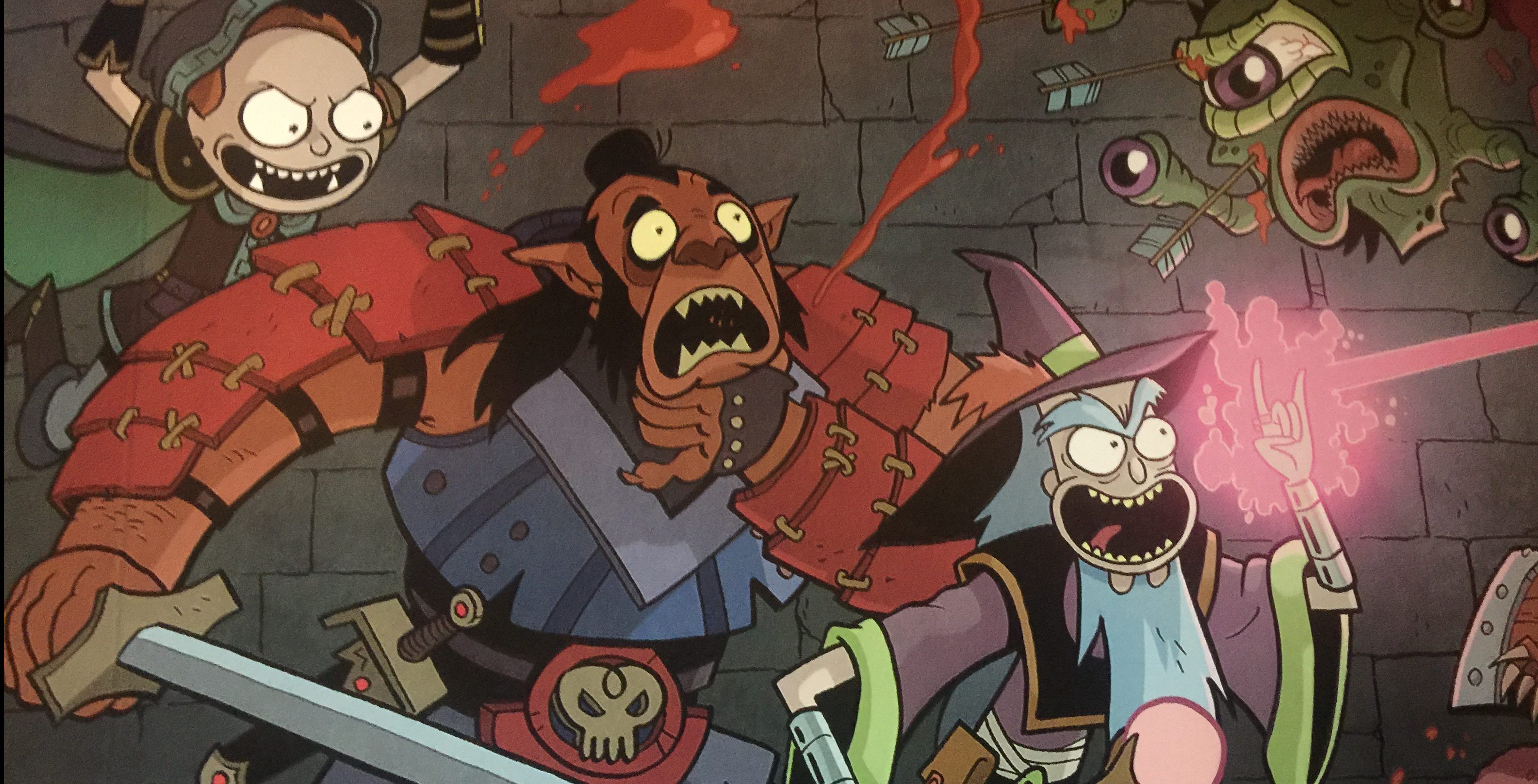
Flipboard: Dungeons & Dragons Vs. Rick And Morty Review: Yes ...


QUIRKY MISFITS SOLVE A CRIME (Dungeon World's approach with Traits thrown in)

Every PC requires XP equal to (current level+4) to level up.

As a group, at the end of every session, answer the following questions:

-          Did we defeat a powerful foe?
-          Did we discover a valuable treasure?
-          Did we learn something new and important about the world?
-          Did we work together to achieve our goal?

For every one you answered yes to, gain 1 XP.

In addition, each PC should write two traits that define their character. Traits should be an action or behaviour that disadvantages the PC in some way. For instance:

Honourable – Refuse to gain an unfair advantage over a foe
Impulsive – Reject planning to leap into a problem
Kind – Help someone weak at a cost to myself

You may gain 1 XP if you act out one of your traits per session. You may not get this XP more than once.
These Actors Star In The New 'Scooby-Doo' Movie

This is your modern cooperative approach, and also basically Dungeon World's XP triggers. The basic unit is the team, the PCs differentiate themselves through characterisation, but really the aims are pursued as a party, there's an implied wider narrative and collective team goal. I don't know if this approach counts as OSR? There's interpretations where players are problem-solving, and your PC's endearing flaws are played out up until it starts to negatively impact the efficiency of the party.  

A PbtA player-as-a-barbarian would absolutely insult the troll king mid-negotiation because it's what the fiction demands. An OSR player, not so much, I think? I feel I need to see how other tables and play cultures handle this. 

-----

The thing is, all of these approaches remind me a little of how D&D as a genre is really very American. By which I mean the central conceit is that you have these rugged individualist types running around, problem solving or actualising or seeking treasure, and they're making their mark on the fictional world and also becoming more skilled and capable versions of themselves.

I was reading a blog-post which I cannot find anymore for the life of me, which argued that early Gygaxian D&D wasn't drawing from european sources, but from the Wild West: these enterprising types going out into essentially untamed wilderness and coming back with treasure.

Are there other ways of playing D&D? Reading counter-colonial Hexcrawl and marxist D&D have me thinking of alternative reward structures in addition to alternative campaign framings, but all the ones I know lean in the direction of story-games: XP triggers that seem to reward a particular genre experience. 'XP for opposing tyranny' or 'XP for wealth redistribution' seem to make assumptions about 'correct' moral values which run against the freedom of sandbox play.

What do?