Showing posts with label rules. Show all posts

Saturday, February 13, 2021

Troubleshooting Detachments and Forts

 I'm running custom Detachment rules which are a mash-up of Into the Odd's company rules and Apocalypse World's gang-sizes so that ship crews in my pirate game interact smoothly with PC combat.

Because this is a think-piece about custom rules I made myself, built on the foundation of the system I kludged together, this post is probably me just talking to myself.


I still don't like it. The mouth-feel is wrong.

The problem is that kludges I put together (like the Area and Large-Scale tags) are non-diegetic. There's really an arbitrary distinction between what counts as 'Area' vs 'Large-Scale'. There's still too much GM overhead, and if I forget to include 'Area' or 'Large-Scale' tags on a monster, then they're stuck doing Impaired Damage (d4) to Detachments, which means 40 peasants (+4 Bonus Size AV) are functionally immune to single monster. Bad. 

THOSE rules are because I used an escalating bonus Size AV of +2 damage resistance per size category advantage. And THAT rule is because I wanted to have a quick way to scale up 'X number of HD1 mooks', keeping their HD and not having to create a hit-point sink.

I generally run low HD human opponents, because PC health is also low. You're more likely to see an army of HD1 peasants or HD3 soldiers than HD8 legendary heroes.

So: new rules. 

Detachments still get a bonus damage die and +2 Size AV per category. Individual-scale opponents still deal Impaired damage (d4) unless they use weapons with an Area Tag

Now, the GM has discretion to ignore Size AV if the situation seems appropriate. PCs setting up explosion traps all along a gulley will do that (and probably get the Area Tag) too, or using choking gas. For monstrous foes, they ignore Size AV if they still fight effectively against large numbers of foes. 

Like this:


Or this:


Basically, if you can imagine them like Sauron in the first LotR tossing soldiers around, then they ignore Size AV. They still do Impaired Damage (d4) unless they have an Area attack, because they'll have to whittle their foes down. 

Peasant armies can still, eventually, kill a dragon. 80 peasants get +3 bonus damage dice: give them all muskets and they're doing 4d8 damage a pop. The problem is keeping them together with Morale Checks as more and more of them die.

The distinction between Impaired damage but ignores Size AV (eg, big ogre smashing fools with a club) and Area damage but minus Size AV (eg, single PC throws a grenade at the enemy squad) still requires a little bit more GM adjudication than I'd like, but I guess I can try these rules out for now.


Monday, January 18, 2021

Mutiny Rules / Pay


Rules are generated out of necessity.

A few sessions ago, my players ran out of food and tried to eat their own crew for the second time. The crew has been entirely wiped out and re-hired three times now.

I need some mutiny rules.

I played around with modifying the Injury and Death / Ship Damage rules for simplicity and consistency, but I'm thinking of trying a Dice Pool instead for that ol' gambling feel. 

MUTINY RULES

When PCs give their crew a reason to be dissatisfied, Add Dice to the Mutiny Pool, then roll all the dice in the pool.

Minor Grievance (+1d6)
- Crew is inconvenienced or treated poorly
- Crew is forbidden from doing something they want to do
- Crew members are placed in danger

Significant Grievance (+2d6)
- Crew members are killed in the normal course of events
- Crew members are placed in reckless danger
- Crew is promised pay, and they are not paid

Severe Grievance (+4d6)
- Half the crew is killed 
- Each week at sea with no food
- Crew is actively sacrificed for the PC's benefit, and the Crew finds out

If any dice show a 1, roll 1d8 on the MUTINY TABLE and add the number of dice in the Mutiny Pool (MP). 

MUTINY TABLE 
1-2: MP +1D. No other effect
3-4: MP + 2D. No other effect
5-6:  MP + 1D Crew is demoralised. Impaired Damage to enemies of the PCs until the next Port Rest 
7-8: Crew demands additional pay now (Does not count as Port Rest, not paying is a Grievance)
9-10: MP +2D. Crew is fractious. They refuse to fight at all until the next Port Rest. 
11-12: MP +3D. Crew is openly rebellious. They refuse to take any orders without incentives
13+: Mutiny! The crew attacks the PCs and tries to seize the ship

PORT REST
To reset the Mutiny Pool, PCs must let the crew rest in town for a week and pay them their regular wages. This replaces the old system of paying wages regularly: now wages are a way to reset the Mutiny Pool.

The idea of wages isn't very piratical, but I don't like the math that comes with calculating loot shares.


Friday, June 26, 2020

Detachments, Forts and Large-Scale Battles: Part 2, Integrating Sub-systems

Don't Mention the Corpses: The Erasure of Violence in Colonial ...

Note: This post is a continuation of this post-mortem.

A post on Gundobad Games about adapting ItO for Domain-play pointed out solutions for scaling Detachments: to steal from Apocalypse World's lovely gang-system, which I've used before and loved.

Detachments and Size

The basic idea is that Detachments now have an additional size, based on the number of people in the unit.
Small (20+)
Medium (40+)
Large (80+)
Huge (160+)

So, two Small Detachments can combine to form a Medium one, two Medium Detachments can combine to form a Large etc etc.

This means I can still use ship stats with specific Crew Scores, as each point represents 20 sailors. So a Sloop with Crew Score 2 can field 2 Small Detachments, or merge everyone into a big angry Medium Detachment of pirates.

For every step of size advantage against a target, a Detachment gains +1 bonus dmg die, and +2 AV. (The base +1 dmg / +1 armour in AW is far too low, because it's based around a system where everything has about 6 HP)

Individuals attacking a Detachment suffer those size penalties, and deal impaired damage (d4) unless they use Area attacks. Detachments can hit multiple individuals at once.

Instead of HD reflecting size, the HD of a detachment is equal to the HD of a single member. Their damage die is based on equipment. Since there are 20 men per Small Detachment, you'd just multiply the cost of, say, a pistol, by 20 to equip them all with pistols.

So a Small Detachment of twenty HD3 Grenadiers wielding sabres would look like this:

Grenadier Detachment, HD3, Small, Sabres (d6)

If they go up against an individual PC, they gain +1 bonus dmg die and +2 AV, or:

Grenadier Detachment, HD3, Small, Sabres (2d6), AV2

Considering that individuals always deal impaired damage to Detachments without Blast weapons, that AV2 means there's a 50% chance that lone PC won't make a dent on the unit. But the reverse is true if the Grenadiers go up against 40 goblins: they'll be rolling 1d6 against AV2. Those are still better odds than that PC had, especially since those goblins are HD1 and have 3HP collectively.

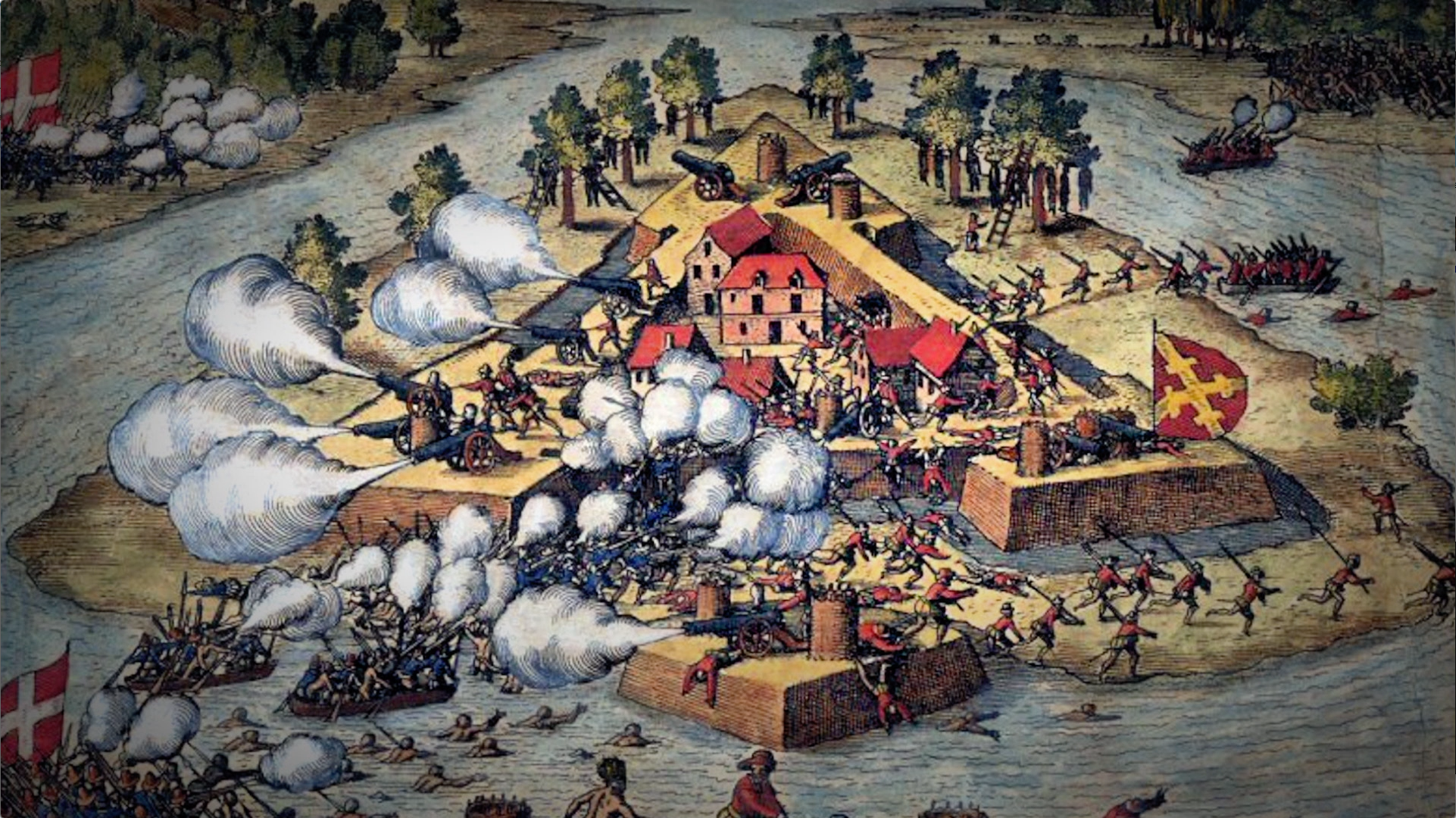
If a Detachment is dropped to zero HP, they drop a size and Test Morale. I'm putting a placeholder 1d6 as the Morale Die for now, since Detachment HD doesn't scale that high. A Small Detachment dropped to zero HP is wiped out. This means that there are now 3 failure-states for Detachment-level warfare:

1) Detachment is destroyed (if it's small)
2) Detachment is reduced but stays in the fight
3) Detachment is reduced and flees / surrenders


Secrets of the Dead | Spanish and French Battle for Florida ...
Fortress rules

Forts

Forts use similar principles. They're rare enough that I didn't mind assigning arbitrary HD values, but they all have a Size and additional AV based on the type of fortifications. This also makes it easier to make rulings on what happens if a Detachment were to eg, hole up in a tower. I'd give them either +AV2 or +AV3 depending on whether I thought the tower was closer to a palisade or stone walls.

As so:

EXAMPLE
SIZE
AV
STATS
SUPPLIES
Outpost
(20-man Garrison)
Small
Sandbags (+AV1)
Level 2, d6
A few days
Wooden Fort
(100-man Company)
Medium
Palisade (+AV2)
Level 4, d8
A week
Coastal Fort
(400-man Battalion)
Large
Stone Walls (+AV3)
Level 6, d10, Large-Scale
A few months
Star Fort
(1000-man Regiment)
Huge
Reinforced Fort (+AV4)
Level 8, d12, Large-Scale
Years

Forts would also benefit from Size advantages. It's suicide for a Small Detachment to attack a Star Fort: it has AV10 AND deals 3d12 damage relative to them.

PCs can attempt missions to lower individual stats: undermining the walls might lower AV, or sabotaging the powder stores might reduce that damage die. Forts should be very hard to take without subterfuge and advance planning, or a huge force-advantage. Or you could siege them.

Forts can create HD2 Detachments of their respective Sizes by reducing their HD by 2.

So a Coastal Fort could create a Large Detachment of HD2 soldiers, in exchange for being depleted to HD4. If an Outpost creates a Small Detachment, well, the whole garrison has up and left.


War Junks | Weapons and Warfare
Ship Rules
Ships:

Ships follow the same Size principles. One exception is that Detachments need Cannon to attack a ship at all. Coastal Forts / Star Forts are assumed to have Cannons.

Ship Sizes are largely equivalent, except for the biggest warships/galleons. It's really there to enable them to interact with Detachments while still keeping manageable damage dice / hull points.

Don't mind all the stats here. The two damage values are the 'stock' and 'maximum' amount of guns. Crew values are probably too low, especially for Warships, but there's a separate sailing sub-system that uses Crew score and this current system leans towards play rather than simulation.


SHIP TYPE
Size
SPEED
MANVR.
HULL
GUNS
CREW (min. / MAX)
CARGO
Raiding Sloop
Medium
12
12
6
d4 / d8
1 / 2
4
Pirate Brig
Medium
11
11
12
d6 / 10
1 / 3
5
Merchant Junk
Medium
10
10
8
d4 / d8
1 / 3
6
Slave-Galley
Medium
8
8
16
d4 / d8
2 / 4
7
Galleon
Large
7
7
16
d8 / d12
1 / 3
9
Patrol Cutter
Medium
13
14
10
d6 / d8
1 / 2
3
Customs Frigate
Medium
11
12
14
d8 / d10
1 / 3
4
Warship
Large
10
11
18
d10 / d12
2 / 4
5


Naval long gun - Wikipedia
Bring the noise
Cannons / Area / Large-Scale Weapons:

You might have noticed the 'Large-Scale' tag in the Fort stats above. I'm still messing around with the terminology: I started with 'Ordnance', though I wondered whether 'Large-Scale' was more direct.

This directly addresses the troll-attacks-a-Detachment problem in the previous post. In Electric Bastionland, individuals deal d4 damage to Detachments unless they do Blast damage.

It's a sensible rule, which I've kept and renamed to the Area tag. This allows an individual creature to hit multiple opponents in 1-on-1 combat, or to keep their damage die in Detachment combat.

(Note: This tag is now very, very important for monsters that want to go up against large groups of foes. In my mind, it makes sense. If a big scary monster can only make 1 or 2 attacks a turn against individual foes, it's essentially the same as doing d4 damage against a Detachment of 20. Then the question is whether the monster can plink the Detachment to death, before they get through its hit-point sink.)

The next tool is the Large-Scale tag. This gives the benefits of the Area tag and allows attacks to ignore Size AV. It should be reserved for especially destructive weapons, like cannons, machine-guns or giant dinosaurs.

The final step is just to declare the creature so big that it's a Detachment itself, which is ItO's solution. Then you'd just run it using Detachment rules.


Test-Run:

So:

Tyrannosaurus Rex, HD10, Bite (2d10), Rampage (d6, Large-Scale)

Let's put him up against 20 brave (foolish?) dinosaur hunters.

Dinosaur Hunters, HD2, Small Detachment, Muskets (1d8)

The dinosaur hunters are a Small Detachment, so they'd do 2d8 damage, whilst the Rex does d6 but ignores Size AV. Considering HD2 is about 6 HP, the Rex would take around 2 rounds to eat through the hunters, and take 4d8 damage (or 4x4.5dmg), for an average of 18 points of damage. The Rex is wounded, but triumphant.

 If 40 hunters got together, that would increase damage to 3d8. The Rex still takes 2 rounds to eat 20 hunters, but now takes around 6d8 damage (or an average of 27 points of damage). The 40 hunters might get lucky and take down the Rex in 1 round, but are more likely to get reduced by half, and have to Test Morale to see if the remaining 20 men break and run. The solution might be to buy them all armour, or hire better soldiers.

The exact numbers would need to be tweaked, but this seems workable.

I'd probably put Cannons at d10, Large-Scale. This also means that Detachments can take cannons off of ships, use the ship damage die, and just the Large-Scale tag.

Maybe cannons could default to the Size of their base ship if used by PCs in individual-scale combat? So a Sloop's culverin would do 3d4 damage if a PC really insisted on taking it with them, because a Medium Sloop gives +2 damage dice.


POSSIBLE PROBLEMS:
- What if a large army of soldiers armed with spears tries to attack a monster that is functionally a tank? The bonus damage dice would overwhelm natural armour, even though an individual spear wouldn't be able to pierce it. The easy solution is to multiply natural armour by number of damage dice, but at this point I can see my players' eyes glazing over.

- Large-scale tags scale downward, but not up. A Large detachment with cannons does 3d10 damage against a yeti, compared to the 2d10 of a Medium detachment. But both would do 1d10 to a Huge detachment. I'm ok with sacrificing this level of granularity.

- Does this system incentivize throwing together ludicrous numbers of peasants, indifferently arming them, and sending them against foes? ...Actually, is this a problem?


Wednesday, June 3, 2020

Combat is an OSR Puzzle


This post is a continuation of this one, which talks about doing away with initiative entirely, while a combat example on Lithyscape crystallised some ideas that had been kicking around my head.

I once attended a pick-up game of D&D at a local community centre. It was terrible: the GM was new and inexperienced, and fully 2 hours of a 4 hour session was spent on a fight with some introductory kobolds. It was like pulling teeth, that combat. Enemies were all hit-point sink, the only complexity was which kobold to attack, and because it was an introductory fight we'd been railroaded there and the only way forward was through.

 A large part of that could be chalked up to GM and player inexperience, but the whole thing soured me on elaborate combats with complex stats. My take-away was combat is tense but should be brief, and short, and we should get it over with as soon as possible.

I can't be the only one who thinks this way. There's lists of OSR challenges or traps which provide all sorts of ingenious set-ups for players to deal with, but I rarely see similar lists of combat situations on OSR blogs. Combat is the lethal thing that parties might die to, it's a semi-fail state for when the plan doesn't work, or a glorious lop-sided affair where the PCs wipe out their foes with poison, ambush, and bomb.

What if combat wasn't that, but a continuation of OSR puzzle-solving?

A lot of fixes I've tried with combat are mechanical (lower HP pools, auto-damage, death and injury tables), but here's a procedural one. (I'm trying to run an initiative-less system, but conceivably this could work for trad initiative-resolution combats too)

PROCEDURE:
1. Every round, the GM establishes a new tactical situation
2. The party discusses their approach
3. The GM resolves the collective approach, calling for rolls as appropriate

This isn't an earth-shaking new mechanic. There's plenty of GMs who do something like this, maybe broken up into initiative order, but I want to try explicitly seeing each round as an OSR puzzle.

The GM draws inspiration from the list below, and mixes them up. If this was a PbtA game they'd be GM Moves, or whatever.

ELEMENTS OF A COMBAT PUZZLE:

1. Enemies just deal damage 
Eg. The goblin warriors rush forward, hacking at your shields and trying to slash you. 
NOTE: I'm using Into the Odd's automatic damage. Enemies in this situation just do damage at the round's end.

2. A wind-up threat -> Something that threatens greater consequences if not dealt with
Eg. The poison bombardier stands at the back, mixing up vials into a grenade bottle.
The wizard waves his hands, and arcane sigils float in the air.

3. Limit their freedom of action
Eg. The room is filled with waist-deep water.
Assassin vines grasp at your feet.
The floor is slippery and covered with grease.

4. Separate them
Eg. Doeg the fighter stands on top of the cross-piece. Far below, Lucius duels the pirate captain.

5. Factor in terrain
Eg. The air is filled with soporific fumes.
Thick choking smog fills the room.
The volcano around you rumbles, spewing lava.

6. Threaten something they care about
Eg. One of the goblins peels off and runs towards your cowering hireling.
An orc carrying a torch runs off towards the wall. He's going to blow the bomb!

7. Offer a prize out of reach, with or without time pressure -> Read broadly, this can be a valuable treasure or some sort of opportunity.
Eg. Behind the spearwall, the priest is legging it with the jewels!
As you fend off the blows of the shadow creature, you think you hear someone muttering and chanting behind the wall. Is it the caster?

There's probably others I haven't thought of, and anyway, they overlap. Reading broadly, a GM might cobble together a simple scene. Here's one from Sacré Bleu, which my players are currently running through.

It combines elements of dealing damage, having a wind-up threat, using terrain and limiting their movement.

The goblin riflemen rain fire down on you from the safe position on the hill-top. Behind them, a trio of goblins are manhandling a cumbersome weapon into place. The rock you're crouched behind gives some cover, but stepping out from behind it means braving a fusillade of shots. 

There's all kinds of things going on behind the scenes here. By default, the goblins are dealing reduced damage, but are hard to reach. Stepping out from the rocks would probably require some kind of Dex Test to not take additional damage. If the PCs don't get past the line of riflemen to take out the goblin weapon-crew, the machine gun opens fire and blows through their cover.

The advantage of this is that the GM is free to slow down combat and make it an interesting puzzle that PCs can discuss, or just speed it up and say Ok there's four ant-men and they all run at you angrily trying to bite you.

Every round, the GM creates a new tactical scene based on the resolution of the last.

Doing Away with Initiative

I've been trying to strip down game systems as much as possible recently. The OSR philosophy of 'rulings not rules' has felt wonderfully freeing, and Into the Odd/Electric Bastionland have sold me on roll-under systems, simple stat arrays, and dealing automatic damage (more on that some other time).

It's Initiative rolls that have been bugging me for a little while.

There's something about that formal switch into 'combat' that signals that this, this kind of interaction, is somehow fundamentally different from other kinds of interactions in D&D play, not to mention the rigid turn-taking seems forced and arbitrary.

I thought switching to Testing Dex to see if you go before/after monsters was elegant, but I eventually realised that, after the first round, it doesn't make any functional difference whether PCs go before or after. Let's say Shloo, Kouda and Eli are all fighting a bunch of goblins. They Test Dex and Kouda goes before the goblins.

The round looks like this:

ROUND 1:
Kouda
Goblins
Shloo 
Eli

ROUND 2: 
Kouda
Goblins
Shloo
Eli

See the problem? There's technically a whole chunk of actions spilling over from Round 1 to Round 2 that's really just one big group phase: Shloo, Eli and Kouda all act, and then the goblins act. For multi-round fights, by Round 4 or 5, you're basically just doing group actions.

Reading this post and this post made me think that having initiative isn't really buying any additional tactical choices for a party. At the same time, I'm not sure an initiative order that fluctuates based on attack rolls is much better: it's more randomness, but it also has weird edge cases that make it hard to come up with group plans. More so because I've committed to using automatic damage and roll-under stat, and I don't want to add in complexity I've already taken out.

I think anything that makes combat more like non-combat problem-solving is great, so I'm going to try something a little bit like PbtA, where actions of PCs and NPCs are happening simultaneously.

It would look something like this:

Every round, the GM sets up the situation in front of the PCs (in the same way that the GM gives information to prompt a choice in non-combat situations). The default is that most foes are simply charging and attacking, but the GM is free to hint at especially damaging foes winding up an attack, or introduce dilemmas.

Example: The five goblin warriors charge at Shloo, Eli and Kouda, swinging their swords. Behind them, the beast-master is fiddling with the mechanism of the lock on the slime-hound cage...

PCs declare collectively, before any dice are rolled, what they will individually do. They're free to attack (which automatically hits and deals damage), try out lateral solutions, or explicitly try to interrupt foes.

Example: Kouda will fire his pistol at the goblin warriors. Shloo tries to push past the goblins and cast sleep on the beast-master. Eli will help Shloo.

The GM adjudicates and resolves actions simultaneously. Damage is automatically done, unless PCs have explicitly found a way to negate or reduce damage (I'm using 'impaired damage' rules from ItO that downgrade weak hits to a d4)

Example: The goblins collectively deal their damage to Shloo, Kouda and Eli based on positioning. Kouda deals damage to the goblins. Shloo makes a Strength Test to push through, with Advantage because Eli is helping, then casts sleep. If she fails, the beast-master releases the slime-hound, which will make its attack.

Conceptually, I'm thinking of the PbtA concept of hard vs soft moves. PbtA can sometimes be a little too PC-centric for my taste, but I like the central idea that the GM introduces a complication, and then PCs roll to respond to it. Whereas in PbtA, the 'soft move' assumption is that damage can be avoided (The goblin is hacking at your shield! What do you do?), here the OSR combat-is-deadly assumption is that damage is a given, and you want to end the combat quickly before it becomes a problem.

There's plenty of grey areas of course: PCs shouting 'I shoot him before he can fire!' for instance. But I wonder whether I'm just over-complicating this: one of the appeals of the OSR philosophy is being able to make rulings on weird edge cases, and there's a whole arsenal of tools that OSR GMs have for non-combat encounters (Fortune rolls, Advantage/Disadvantage, Test a stat, so on and so on). As a GM, I could probably figure something out.

Note:
In the edge case above, I'd say that attacks that aim to kill or incapacitate are already the assumption of automatic damage, so the player would deal and take damage as per normal. But maybe they could trade reduced damage to reduce an enemy's damage die with harassing fire...

But what about getting the drop on your enemy???

This is the one advantage to an initiative system that I can think of. I'd just adjudicate surprise as a separate thing in and of itself: if your PCs achieve surprise, they do damage before anyone can act. Vice versa for your NPCs. Neat and simple.


Thursday, April 23, 2020

Alternative XP Systems


So I've been thinking about XP systems as a driver of play recently. I've been spending quarantine throwing together a hack of the GLOG, the Black Hack 2E, and other bits, and I was writing up different XP systems and trying to represent different schools of thought.

Please note that all titles are the actual ones I've used in my hack, and are entirely self-deprecating.


GRASPING CAPITALISTS (blatantly stolen from Goblin Punch)

Over the course of your adventure, you might discover Treasure, if you look. You will know it when you see it. (eg, a jewelled egg the size of a fist, a coruscating crystal of pure life-force, an ancient tome with the names of all the angels)

Each Treasure is worth one level, to only one player. At the end of the adventure, discuss as a group who contributed the most to the party and why. That player takes a d12 die. Discuss who was the most entertaining, and why. That player takes a d10. They cannot be the same player. Then everyone rolls:

1d10+(Bonus die)

Give out Treasure in order from highest to lowest rolls. Re-roll ties. Loop around if you somehow have more treasure than players. 

This is really for me the distillation of the OSR gold-as-xp approach: you're meant to go into dungeons and weird places. You're meant to stick your hand down weird holes and feel about for things and pull out glowing gems from frog-idols and run away from yetis that don't want you to take the gems.


Rhys-Davies dishes on new 'Indiana Jones' Blu-ray treasure | Newsday

IMPULSIVE MANCHILDREN  (The Black Hack's approach)

Every PC requires XP equal to their level to advance.

Every session, XP is awarded for the following activities:

-          Failing catastrophically in an entertaining way
-          Overcoming an important named foe or obstacle
-          Seizing an especially valuable treasure
-          Completing a quest for an NPC
-          Achieving some difficult and worthwhile personal goal

If in doubt, the table discusses if it’s worth an experience. This rewards PCs for all the screwing around they were going to do anyway. Awarding XP for a 'difficult and worthwhile personal goal' is really just codifying giving players XP for the ludicrous things they already want their PCs to do, like declaring a personal vendetta against the town shoemaker because of reasons.

Really, this is a sort of PbtA approach to XP. Whatever the characters choose to do is ipso facto an important act. XP for you! And XP for you! XP for everybody! Pursue your bliss. 

XP for catastrophic failure is also very story-games. The intent is less on solving problems and overcoming challenges, and more just poking a reactive world and seeing what happens. Failures are entertaining detours, not something to avoid with conservative play.

Flipboard: Dungeons & Dragons Vs. Rick And Morty Review: Yes ...


QUIRKY MISFITS SOLVE A CRIME (Dungeon World's approach with Traits thrown in)

Every PC requires XP equal to (current level+4) to level up.

As a group, at the end of every session, answer the following questions:

-          Did we defeat a powerful foe?
-          Did we discover a valuable treasure?
-          Did we learn something new and important about the world?
-          Did we work together to achieve our goal?

For every one you answered yes to, gain 1 XP.

In addition, each PC should write two traits that define their character. Traits should be an action or behaviour that disadvantages the PC in some way. For instance:

Honourable – Refuse to gain an unfair advantage over a foe
Impulsive – Reject planning to leap into a problem
Kind – Help someone weak at a cost to myself

You may gain 1 XP if you act out one of your traits per session. You may not get this XP more than once.
These Actors Star In The New 'Scooby-Doo' Movie

This is your modern cooperative approach, and also basically Dungeon World's XP triggers. The basic unit is the team, the PCs differentiate themselves through characterisation, but really the aims are pursued as a party, there's an implied wider narrative and collective team goal. I don't know if this approach counts as OSR? There's interpretations where players are problem-solving, and your PC's endearing flaws are played out up until it starts to negatively impact the efficiency of the party.  

A PbtA player-as-a-barbarian would absolutely insult the troll king mid-negotiation because it's what the fiction demands. An OSR player, not so much, I think? I feel I need to see how other tables and play cultures handle this. 

-----

The thing is, all of these approaches remind me a little of how D&D as a genre is really very American. By which I mean the central conceit is that you have these rugged individualist types running around, problem solving or actualising or seeking treasure, and they're making their mark on the fictional world and also becoming more skilled and capable versions of themselves.

I was reading a blog-post which I cannot find anymore for the life of me, which argued that early Gygaxian D&D wasn't drawing from european sources, but from the Wild West: these enterprising types going out into essentially untamed wilderness and coming back with treasure.

Are there other ways of playing D&D? Reading counter-colonial Hexcrawl and marxist D&D have me thinking of alternative reward structures in addition to alternative campaign framings, but all the ones I know lean in the direction of story-games: XP triggers that seem to reward a particular genre experience. 'XP for opposing tyranny' or 'XP for wealth redistribution' seem to make assumptions about 'correct' moral values which run against the freedom of sandbox play.

What do?